Elizabeth “Betty” Wright Norris, June 7, 1943 – January 28, 2017
“It is such a mysterious place, the land of tears.” – Antoine de Saint-Exupery, The Little Prince
January 28th marks the anniversary of the death of my adoptive mom. This year makes nine years. Every year, the date quietly echoes in my heart—but this year, the ache feels deeper. I think it’s because, after all this time, I’m finally back “home”—just three hours away from where I grew up. But she’s not here. I can’t drop by to visit. She’s not here to meet my own adopted children. I can’t sit with her and talk about what adoption was like for her—what it meant to bring my brother and me into her life—and I can’t share my own experience as an adoptive mom now walking that same road.
There have been so many moments lately when I’ve longed to talk to her, to ask her questions I didn’t think to ask before, to connect our stories as mothers bound by love and choice. But all I have now are memories—and the words I shared at her funeral.
Most people I grew up with didn’t know me as “Elizabeth.” Some might wonder why I started going by my middle name. The answer is tied to her. It’s all part of this story.
So today, in her memory, I want to share the eulogy I gave at her funeral.
It’s a tribute to her—and a glimpse into the story of how there came to be two “Elizabeths.”
*****
Eulogy for Elizabeth, My Mom
I often get asked about my name, or names to be more specific. Pennie Elizabeth. Shortly after adoption, my adoptive mom, Elizabeth Jean, asked if I would take her name “Elizabeth.” I wasn’t ready to accept that I would never see my “real family” ever again, and this request seemed to confirm my suspicion. Tentatively, I compromised and agreed to use “Elizabeth” as my middle name, clinging to “Pennie” like a familiar security blanket, certain that it was my portal back home.
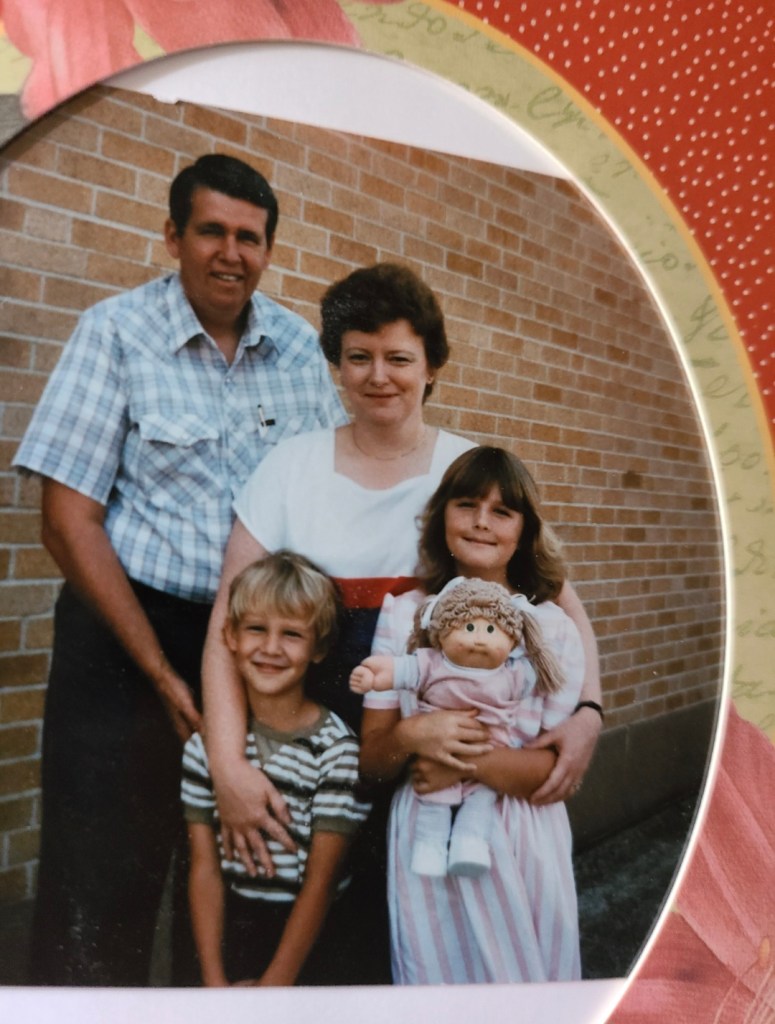
Mom and I never got along. We only have one picture we ever took just the two of us. It was shortly after adoption, probably the winter of 1986, and we were still happy and hopeful that this could work. We’re wearing matching outfits, blue button-down shirts and jeans, and she has her arm around me while I’m sitting on her lap. We look content with each other.
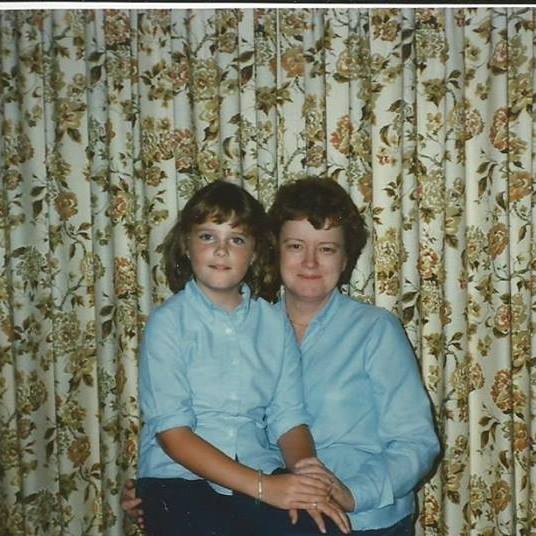
We had difficulties communicating with each other. The more I tried to talk about my “real family”, the more withdrawn she became and there remained an awkwardness between us that manifested in exchanges of angry words wrapped in sorrow.
I did not want to be her daughter. I cringed when strangers commented on our resemblance. They never suspected we were not biologically related. I quickly would set them straight and make sure they knew she was not my “real” mother. I was not her daughter, and I certainly didn’t want others to think otherwise. She was too reserved and serious to be my mother. She was not the mother I wanted.
The truth was we were too much alike both in character and shared painful life experiences that the walls never came down. Every now and then I caught glimpses of what she could be like, but her guard was too high. Not understanding her reserved demeanor, I let the void between us remain. In those rare moments when we seemed to get closer, one of us would say or do something and we would retreat behind our walls, peeking out at the other.
As I grew into my teens, though, I began to respect this woman who grew up in poverty and an abusive home. She was the oldest of six and her mother died young, leaving my mom as the sole caretaker of her younger siblings while her father drank himself into a slumber. She often had lice and only had one or two outfits she wore to school. At 16, she fled the family home and never looked back. She put herself through nursing school, and after nursing school, spent two years in Africa as a journeyman nurse. She eventually obtained her PhD in nursing and began teaching nursing at the university.
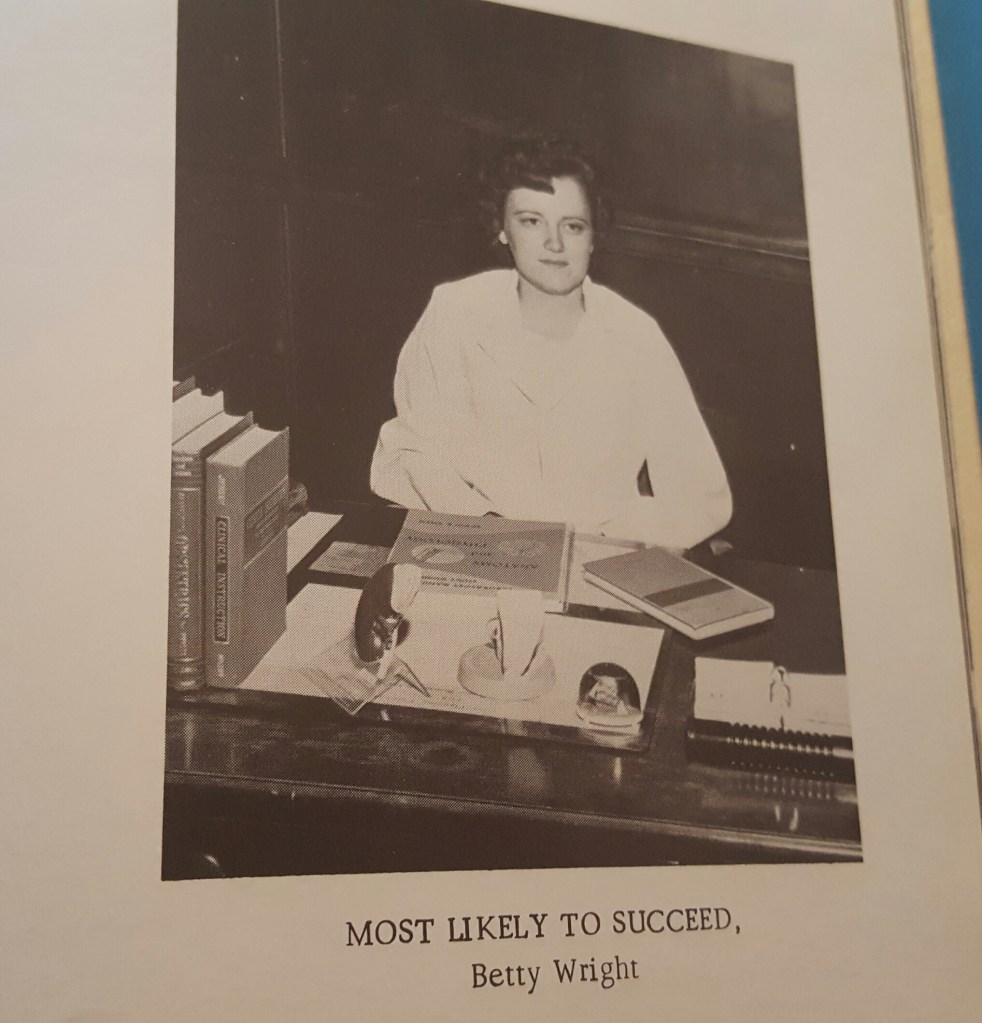
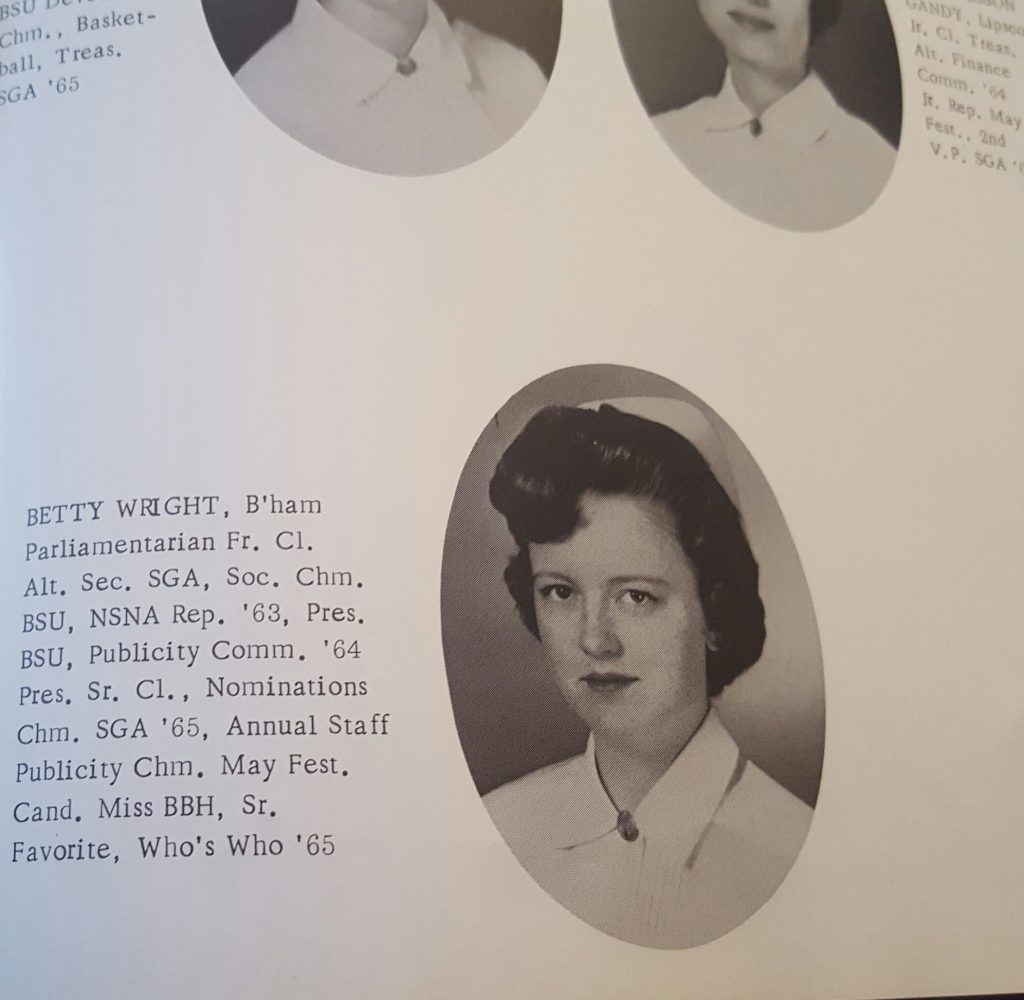
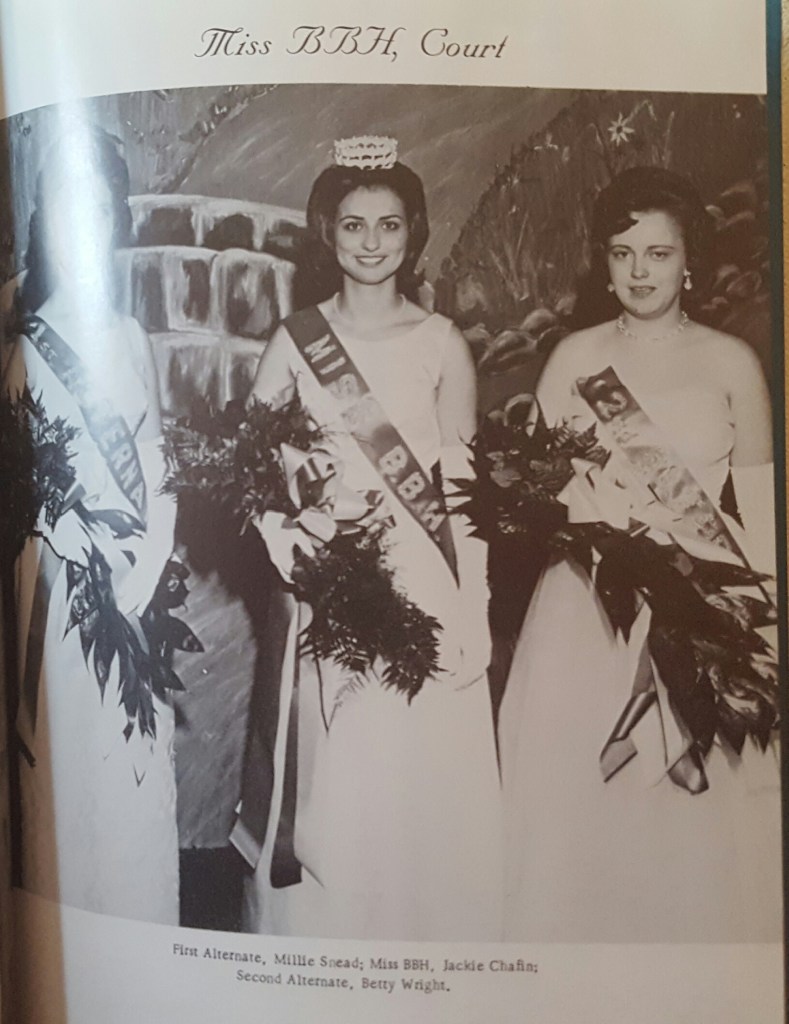
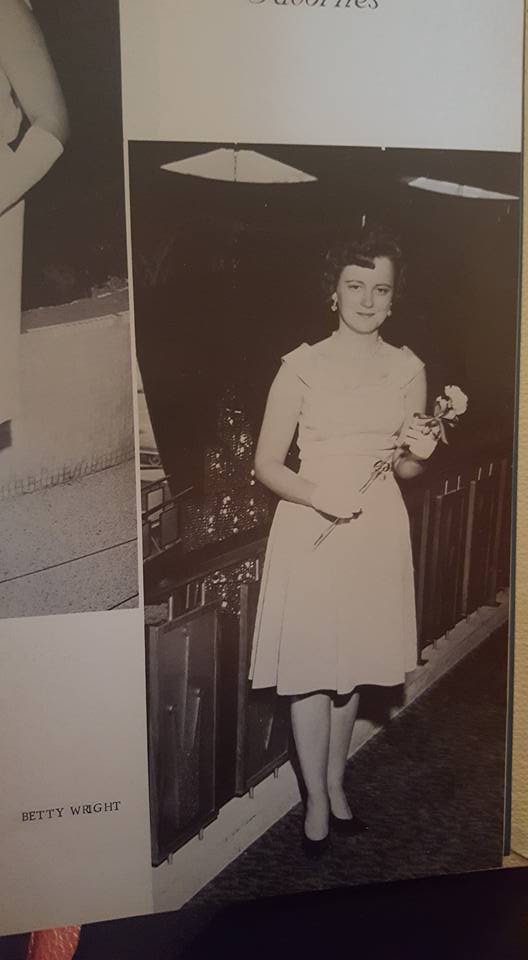
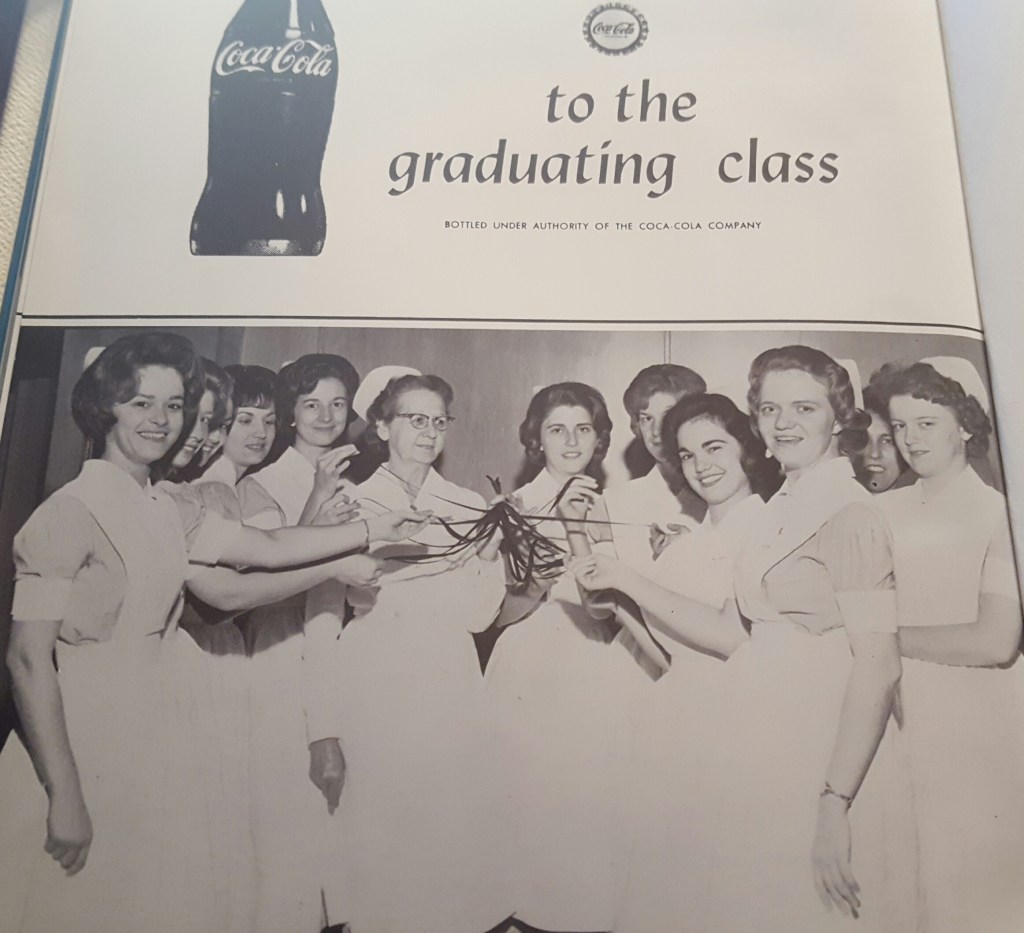
I remember mom began the PhD program shortly after adopting my brother and me. She worked long shifts at the hospital, often all hours of the day and night, and studied in her free time. Some of my favorite memories are when she would take my brother and me to the hospital with her on our days off from school. No matter where we went in the hospital, people would stop her with a question, and she always had an answer. She was so smart. I saw how others looked up to her and admired her practical thinking. Soon after earning her PhD, she earned a world-renowned reputation, becoming a widely sought after consultant as far away as South Korea.
I was in college when we finally began communicating and understanding each other, thanks to using email. Being able to talk using a keyboard seemed to be the way to open the lines of communication between us. It felt safe and allowed us to slowly get to know each other. Before then, we fought constantly and rarely spoke to each other when we weren’t fighting. We each felt rejection from the other. I was very emotional and wore my heart on my sleeve, while she was very practical and rarely showed any emotion. But we both longed for acceptance from the other.
As I began to understand her, I began to realize that the past I clung to so desperately in “Pennie” was no longer what I wanted. I began to accept this person who may not have been my “real” mom, but was more important to me and influenced me more profoundly than my “real” mom ever could. I knew I owed my future to her. I embraced my adoptive mom’s name as my own and felt its strength envelope me.
She never became the mother I wanted. However, I began to see her as a role model of strength and resilience. I saw how she overcame her abusive, impoverished childhood to do whatever she wanted. This inspired me to be strong, and I began to let go of the “victim” mentality. I realized that by my accepting her, I accepted me.
Shortly after college, I was diagnosed with cancer. I had moved from Alabama to California after college to live with my college best friend, and she was the only person I knew. My mom never liked to talk on the telephone, especially long distance. But as I went through months of chemotherapy and radiation, her telephone calls to check on me and offer me her professional nursing advice bolstered me through very sick days and time spent in the hospital. My friend, and others who knew me, often asked why my adoptive mom wasn’t there physically for me. They couldn’t understand why she didn’t fly to California to take care of me since I could not fly to Alabama with such a low immune system. I understood why they asked those questions, but I knew she was being my mom the best she could for me. It wasn’t perfect, but it was her.
Inspired by her “can do” attitude, I put myself through law school. When I graduated, there was no big celebration, not even a card; but she was there. She flew across the country to be there and by her presence I knew she was proud.
I was in my mid 30s when she began hinting that something was wrong. She used medical vocabulary and words that I didn’t recognize. I didn’t think much about it. Earlier when I was in college, she had been diagnosed with Parkinson’s Disease, and she still seemed the same, so I wasn’t worried. Her doctors often remarked how slow the disease was progressing. Likewise, she was so smart that there was no way she could succumb to a disease that attacked the mind. I ignored any hint her mind might be affected, especially when she could tell me exactly what was happening to her, like a nurse giving a patient a diagnosis.
The first time I began noticing something different was when she stopped emailing me. Ever since we began emailing each other when I was in college, I could always count on her to quickly respond. But there was no response. Then I began calling her. She would clinically explain why her hands could no longer type. But, unlike previous conversations where she gave her diagnosis and symptoms to me, this time she would forget in mid-sentence what she was discussing. At first, I was optimistically dismissive of it. After all, people forget what they are talking about, I would tell myself. And she always remembered once I prompted her. But the promptings increased, and then she began not making sense. I stopped talking to her. It was too much for me to accept.
I felt insulated living all the way in California. I convinced myself that if I didn’t talk to her, she would be just fine. She would still be that practical person on the other line and I would have all the time I wanted to get to know her from a “grown up’s” perspective. I was in my late 30s and I finally felt like I could be friends with her.
I knew something was seriously wrong when I called home and my dad answered the phone. In all the years I called home, he never answered. My suspicions were confirmed when I mentioned I might come home to visit and he immediately agreed it was a good idea.
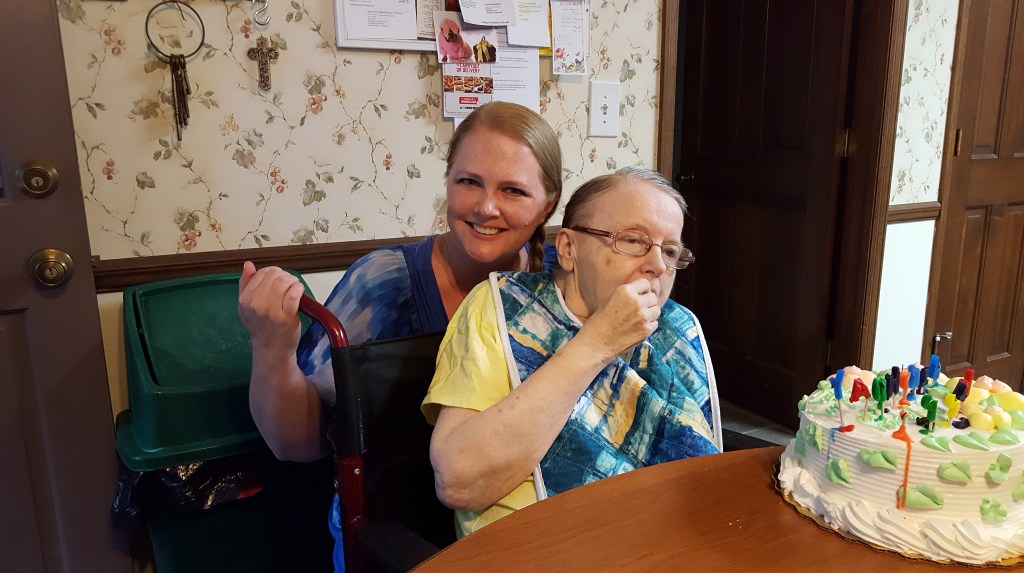
It was June 7, 2016, her birthday, when I saw her again. It had been over seven years since I had seen her last. I didn’t recognize her. My dad was standing next to a frail, shrunken woman in a wheelchair and my first thought was, “Where is my mom?” She looked up at me and when I saw her eyes, I saw something there – a flicker of recognition, and in that moment I knew we recognized each other.
My dad wheeled her into the kitchen to the same table I shared so many meals with her in that house. I could barely eat my take-out meal from Cracker Barrel as I watched my dad put a bib around her and began to feed her the chicken and carrots I picked up for her. I watched as he cut them in bite-sized pieces and gently coaxed my mom to eat each bite. I was still shocked by her unfamiliar appearance. Her once thick auburn hair that she kept short and styled with rollers was barely laying in wisps on her head. From as long as I knew her she was on some diet but could never shed those extra pounds that made her slightly plump, but now she was so thin I almost wanted to pick her up in my arms and cradle her. She always had a fair, creamy complexion that matched her natural red hair, but now her skin was paper white, almost translucent.
Some of her oldest friends came by to visit. As my dad left to greet guests, I was left at the table to finish feeding her. The fork felt like a weight in my hand as I lifted carrots from her plate to her mouth. I couldn’t stop the tears.
As we sang “Happy Birthday” to her, she reached out her hand and scooped some icing off the cake to lick off her finger. My mom was always proper, enrolling me in etiquette classes when I was younger, yet, here she was digging her finger in the cake in front of us, happily licking her fingers. I wanted nothing more to hold her, to cling to her and profess to everyone there that this was my mom. This is my mom, and I am her daughter.
She could talk a little, but it was hard to understand. Her voice was as soft as the whispers that used to float around the house when my brother and I played while she slept down the hall. As we sat in the living room, she sat in her chair, across from me, and stared intently. She would not stop looking at me. I saw the tears fall down her face as she fell asleep.
The woman who gave me her name, her strength, is now gone. This is the story of two Elizabeths. This is the story of a mom and her daughter.
The Day We Became Moms
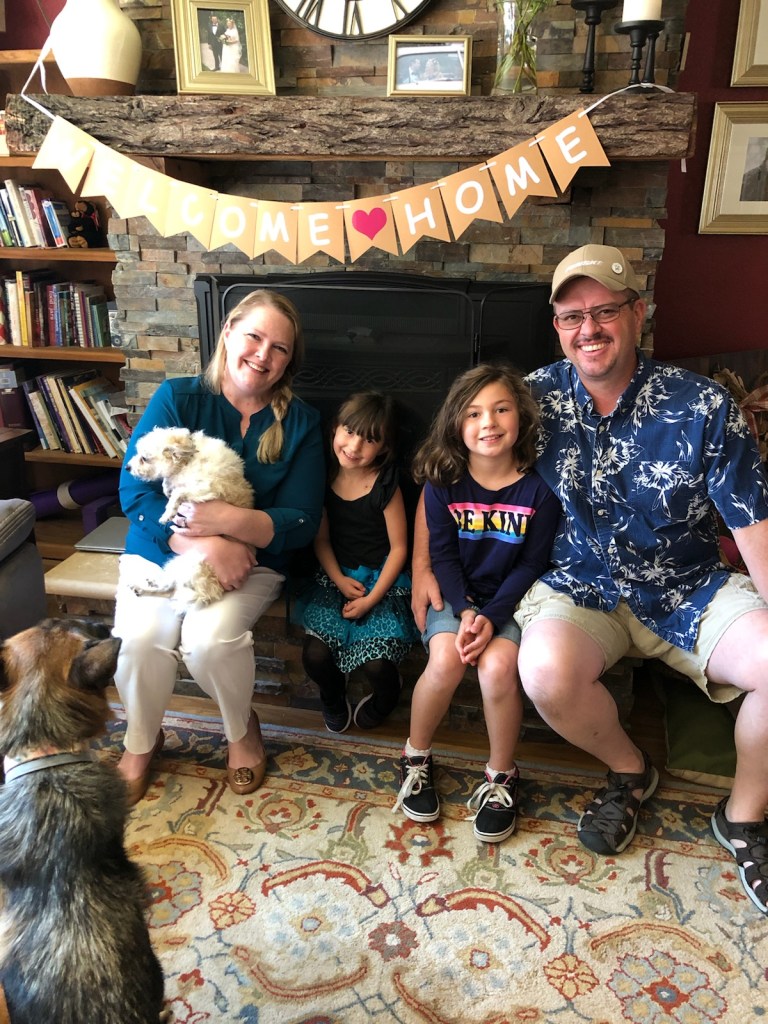
 Coming Home to Dixie
Leave a comment